Ghana & Asanteman Explained: Country, State, Nation

If you live in Kumasi or visit the Ashanti Region, you see many names around you. Republic of Ghana, Ashanti Region, Asanteman, Asante Kingdom. It can feel hard to know what each one really means.
You might wonder why Ghana has a president, a parliament, and a passport, while Kumasi also has the Asantehene, Manhyia Palace, and the idea of Asante yɛ Ɔman (Asante is a nation).
This post walks through those ideas in simple terms. You will see how the terms country, state, republic, and nation apply to Ghana and Asante, and how they fit together without conflict.
By the end, you will be able to explain Ghana and Asanteman clearly to friends, visitors, and even to yourself.

Struggling to Keep Track of All Your Kumasi Adventures? No worries!
With so much to see, do, and learn in Kumasi, it’s easy for the details to get lost. Want to make the most of your explorations? Then you need this FREE Kumasi Journal Set!
It’s perfect for recording your favorite spots, and cultural experiences, and even learning key Twi words and phrases to deepen your connection to Kumasi. Whether you’re a local or a visitor, this journal makes every moment count.
Why Names Like “Republic of Ghana” and “Asanteman” Feel Confusing
In official documents, the country is referred to as the Republic of Ghana. At the same time, many people in Kumasi and beyond speak with pride about Ashanti, the Asante Kingdom, and the Asante nation.
You also hear about the Ashanti Region, an official region of Ghana with its own regional capital, Kumasi, and a regional minister.
Then you have Asanteman, led by the Asantehene and the Asanteman Council, with chiefs and stools.
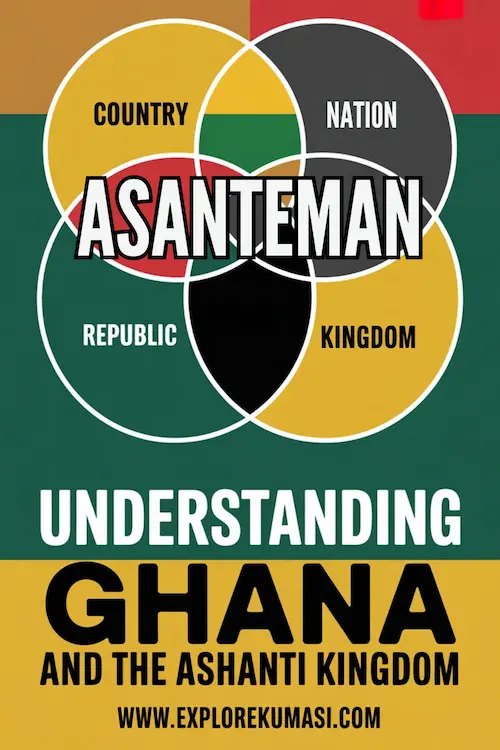
All these labels describe different things:
- Ghana as a country and a republic
- Ghana as a state in international law
- Asanteman as a nation and traditional kingdom
- Ashanti is a region in Ghana
Once you see which term refers to people, which refers to land, and which relates to government, the picture becomes much clearer.
Nation: Asanteman as a People
In simple terms, a nation is a large group of people who share a common history, culture, and often a language, and who feel they belong together.
A nation is about people, not passports. It does not have to match a modern political border. It does not even need to be a separate country.
What Makes a Nation
Most nations share a few features:
- A sense of common identity
- A shared history and stories
- A common or related language
- Shared symbols, values, and traditions
Nations grow over time. They form through war, trade, migration, and shared experiences. The key is that people see themselves as part of one large family.

Asanteman as a Nation Inside Ghana
By this idea, Asanteman is a classic example of a nation:
- The Asante people share Asante Twi as a primary language.
- They share a long history, including the rise of the Asante Kingdom.
- They recognize common symbols, such as the Golden Stool, the Asantehene, kente patterns, and important festivals.
- Many Asante people, in Kumasi and abroad, speak with pride about being Asante, not only Ghanaian.
People say “Asante yɛ Ɔman” to show that Asanteman is a nation, with its own identity and sense of unity.
This nation mainly centers in the Ashanti Region but also includes Asante communities spread across other regions and other countries.
You can be a citizen of Ghana politically, and at the same time belong to the Asante nation culturally. One is about legal status, the other is about identity.
Country and State: Ghana as a Sovereign State
In international law, the words country and state often mean the same thing. They describe a political unit that has control over its land and is recognized by other countries.
Ghana is a sovereign state. That means it has the full right to run its own affairs, sign treaties, and issue passports.

The Four Elements of a State
Most political scientists agree that a state needs four main elements:
- Population
People who live there permanently, not just visitors. - Territory
A defined area of land, with borders that other countries recognize. - Government
A system that runs the country, makes laws, collects taxes, and manages public services. - Sovereignty
The final authority over that land and people, without control from another country.
Ghana fits all four:
- It has people who live there permanently.
- It has fixed international borders with neighboring countries such as Côte d’Ivoire, Togo, and Burkina Faso.
- It has a national government in Accra, with a president, parliament, courts, and many institutions.
- It controls its own defense, foreign policy, and currency.
This is why Ghana is a member of the United Nations and issues Ghanaian passports.
Ashanti Region as a Region of the Ghanaian State
The Ashanti Region is one of Ghana’s administrative regions. It has:
- A regional capital, Kumasi
- A regional minister appointed by the central government
- Districts and municipal assemblies
The Ashanti Region is part of the Ghanaian state. It does not have a separate international status, and it does not issue its own passports.
Comparing Ghana and Asanteman
Here is a simple way to see the difference.
| Aspect | Ghana | Asanteman |
|---|---|---|
| Type | Country, state, republic | Nation and traditional kingdom |
| Who belongs | Citizens of Ghana | Asante people and communities |
| Territory | Fixed borders recognized globally | Centered in Ashanti, but people live wider |
| Passport | Issues Ghanaian passport | No separate passport |
| Main leadership | President, parliament, government | Asantehene and Asanteman Council |
| Sovereignty | Full international sovereignty | Traditional authority within Ghana’s laws |
Ghana is the state. Asanteman is a nation and kingdom within that state.
Republic: Why Ghana Is Called the Republic of Ghana
Many countries include the word “republic” in their official names. Ghana is one of them. The full name is the Republic of Ghana.
A republic is a form of government where:
- The head of state is not a hereditary monarch.
- Leaders are chosen, usually through some form of election.
- A constitution sets out how power is exercised and protects basic rights.
Ghana has:
- A president as head of state and head of government.
- A parliament elected by the people.
- The 1992 Constitution sets the rules for politics and public life.
That is why Ghana is called a republic. The country has had several republics since its independence. The current political era is often called the Fourth Republic.
Some republics in the world are more democratic than others, but the common feature is that power does not rest in a royal family by law.
Traditional rulers, including the Asantehene, are recognized and respected in Ghana’s constitution.
However, the Asantehene is not the head of state of Ghana. The Asantehene is the head of Asanteman and a central figure in chieftaincy and customary matters within the republic.
How Ghana and Asanteman Fit Together
This is where many visitors to Kumasi have questions. How can you have a republic with a president, and at the same time a powerful king with deep authority and respect?
The answer is that Ghana and Asanteman operate at different levels.
- Ghana is a country, state, and republic.
- Asante is a nation and traditional kingdom within that country.
The constitution of Ghana recognizes chieftaincy and traditional councils. It sees them as important for culture, customs, and local matters, while the national government handles national laws, foreign affairs, defense, and many public services.
Ashanti Region vs Asanteman
People often mix up the Ashanti Region and Asanteman, but they are not the same thing.
- The Ashanti Region is an official region of Ghana. It is defined by law and has clear administrative boundaries.
- Asanteman is the Asante nation and kingdom. It is based on stool lands, traditional areas, and the authority of chiefs and the Asantehene.
The heart of both is Kumasi. Kumasi is:
- The capital of the Ashanti Region.
- The seat of the Asantehene at Manhyia Palace.
- A cultural capital for Asanteman.
Some Asante communities live outside the formal Ashanti Region. At the same time, not everyone in the region is of Asante origin. This is another reason to see Asanteman as a nation of people, not only a map.
How to Explain Ghana and Asanteman to Visitors
If you host friends from outside Ghana or from other regions, these steps can help you clearly explain things.
- Start with Ghana as a country.
Say that Ghana is a country in West Africa, a sovereign state, and a republic with a president, parliament, and constitution. - Describe Ghana as a state with regions.
Explain that Ghana has several regions. One of them is the Ashanti Region, with Kumasi as its capital. - Introduce Asanteman as a nation.
Tell them that the Asante are a nation of people with a shared history, language, and culture. Asanteman is their kingdom, led by the Asantehene. - Clarify the difference between region and kingdom.
Make it clear that the Ashanti Region is an administrative region of Ghana, while Asanteman is a traditional kingdom and cultural space. - Connect the ideas to what they see.
When you visit places like Manhyia Palace, cultural centers, or Akwasidae celebrations, point out that these belong to Asanteman. When they see Ghana flags, police, courts, or national offices, those belong to the Republic of Ghana. - Summarize in a simple sentence.
You can say something like, “Ghana is the country, Asanteman is our nation and kingdom inside it.”
If you practice this a few times, you will be able to answer most of the questions people have around Kumasi or the wider Ashanti region.
Enjoying This Post? Keep Exploring With Us!
If this post resonates with you, check out our store for fun, interactive ways to explore Kumasi, the Asante Kingdom, and the Ashanti Region. From history and culture to beginner-friendly Twi language learning, we’ve created resources to help you learn, connect, and share.

FAQ about Ghana, Asanteman, and Political Terms
Is Asanteman a country?
No. Asanteman is not a country in international law. It has no seat at the United Nations and does not issue passports. It is a nation and traditional kingdom inside the Republic of Ghana.
Does Asanteman issue its own passports?
No. Only the Republic of Ghana issues passports. People from Asanteman travel with Ghanaian passports like other Ghanaian citizens.
Is Ghana a nation-state?
Many people describe Ghana as a nation-state, but the reality is more mixed. Ghana is a state with many nations and ethnic groups inside it, including Asante, Ewe, Ga-Dangme, Mole-Dagbani groups, and others. So Ghana is one state with several nations.
Why do people call Ghana a republic?
People call Ghana a republic because the country has a president as head of state and leaders are elected under a written constitution. There is no legal king or queen of Ghana as a whole.
Can someone belong to both Ghana and Asanteman?
Yes. This is common. A person can be a citizen of Ghana, with all the legal rights that come with that, and at the same time belong to the Asante nation, with cultural ties to Asanteman, its stools, and its traditions.
What role does the Asantehene play in modern Ghana?
The Asantehene is the king of Asanteman and the head of the Asanteman Council. His role includes:
- Guiding traditional governance in Asanteman.
- Protecting customs, festivals, and cultural heritage.
- Playing a unifying role among the Asante people, in Ghana and abroad.
He works within the wider legal system of the Republic of Ghana.
Wrapping Up: Country, State, Republic, and Nation in Ghana
To recap, Ghana is a country, a sovereign state, and a republic. It has fixed borders, a national government, and international recognition. Inside that state, Asanteman stands as a nation and traditional kingdom, built on shared identity, history, and culture.
When you walk through Kumasi, you move between these layers all the time. The flag at a government office signifies the Republic of Ghana, while stools, Kente cloth, and the presence of the Asantehene signify Asanteman.
If this guide helped clarify, share it with a friend, a visitor, or a family member. Use it the next time someone asks what Asanteman really is.
If you live in or visit Kumasi and the Ashanti Region, take time to learn from elders, visit historical sites, and see how country, state, republic, and nation live side by side around you.
AKWAABA!! IF THIS POST CAPTURED YOUR ATTENTION, KEEP EXPLORING KUMASI WITH US AT ExploreKumasi.com. Yɛdaase!
You’ll find cultural guides, historical insights, and travel resources to help you experience Kumasi and the Ashanti Region more deeply.
💬 Want to stay connected? Join our community on Facebook to share your thoughts and discoveries.
📌 Inspired by what you read? Pin an image to come back later or share with someone planning their own Kumasi journey.
Thank you for exploring with us.