What Asanteman Means in Ashanti History

Asanteman means the political confederacy of Akan states that formed the Ashanti Kingdom under the leadership of the Asantehene in Kumasi.
Before the rise of the Ashanti Kingdom, the forest region of present-day Ghana was home to many independent Akan states. Each state had its own chief, land, and council of elders.
These states did not disappear when Asanteman formed. They formed a confederacy, a political alliance in which different states cooperate under shared leadership while retaining their local authority.
During the seventeenth century, the Oyoko clan in Kumasi began bringing nearby Akan states into a political alliance.
This process involved diplomacy, military cooperation, and shared resistance against the Denkyira kingdom, which controlled the region at that time.
The alliance strengthened when the Asante states defeated Denkyira at the Battle of Feyiase in 1701. This victory allowed the confederacy to declare independence and organize itself as a unified political state.
From that point forward, the union became known as Asanteman, meaning the Ashanti nation.
Historians of the Asante Kingdom often describe Asanteman as a confederacy of states united under the authority of the Asantehene.
Each member state still maintained its local leadership. At the same time, the states recognized the authority of the central government based in Kumasi.
This balance between local autonomy and central coordination helped Asanteman expand and maintain stability across a large territory.

Struggling to Keep Track of All Your Kumasi Adventures? No worries!
With so much to see, do, and learn in Kumasi, it’s easy for the details to get lost. Want to make the most of your explorations? Then you need this FREE Kumasi Journal Set!
It’s perfect for recording your favorite spots, and cultural experiences, and even learning key Twi words and phrases to deepen your connection to Kumasi. Whether you’re a local or a visitor, this journal makes every moment count.
The Leadership Structure of Asanteman
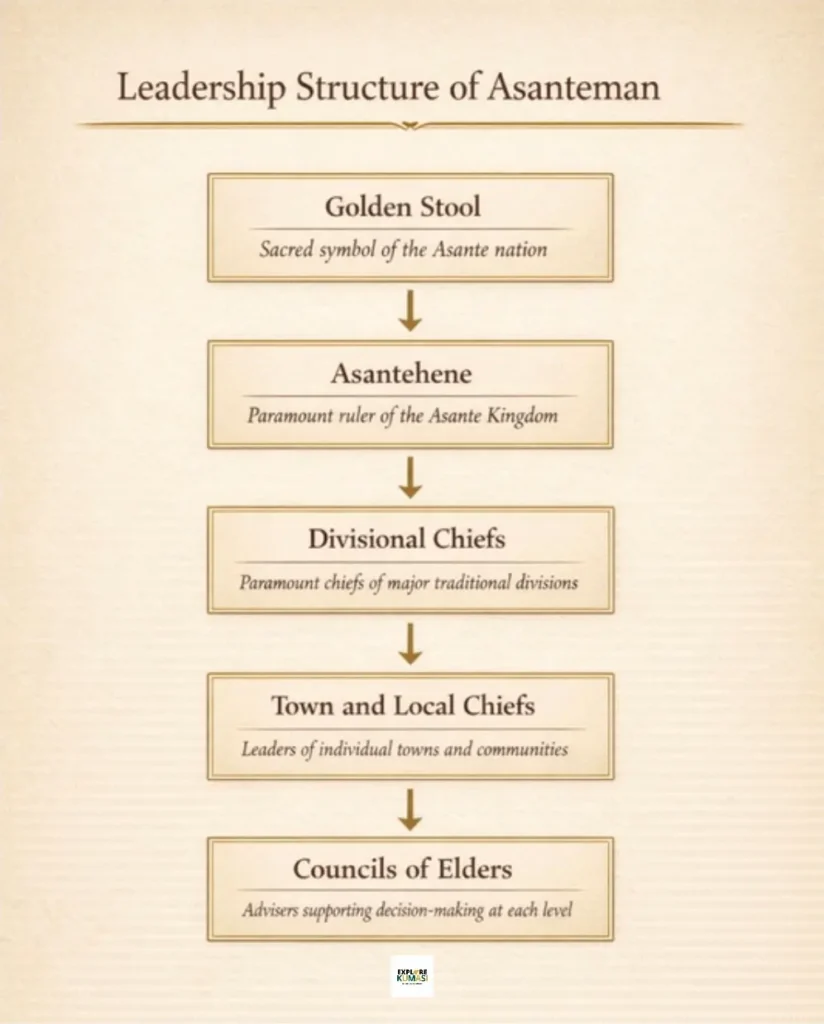
The political system of Asanteman operated through a layered leadership structure.
At the top stood the Asantehene, the king of the Ashanti Kingdom. The Asantehene ruled from Kumasi, the political and ceremonial center of the kingdom.
The authority of the Asantehene rested on three foundations:
• allegiance of the chiefs across the confederacy
• the sacred authority of the Golden Stool
• political decisions made through councils
The Golden Stool (Sika Dwa) became the symbol of unity for the Ashanti people. According to Ashanti tradition, Okomfo Anokye called the Golden Stool down during a gathering of chiefs. The stool symbolized the nation’s spiritual identity and the unity of the people.
Below the Asantehene were divisional chiefs who governed territories across the kingdom. These chiefs oversaw local administration, community disputes, and land matters.
Each level of leadership connected villages, towns, and regions to the central authority in Kumasi.
This structure created a political network that linked the entire confederacy.
Traditional Governance in Asanteman
Asanteman developed a governance system that combined royal authority with collective decision-making.
The Asantehene held great influence, but governance depended on councils and assemblies that represented different parts of the confederacy.
One of the most important institutions was the Asanteman Council. Chiefs from across the kingdom gathered to discuss political matters affecting the entire state.
Council discussions addressed issues such as:
• succession of chiefs
• disputes between communities
• military defense
• diplomatic relations
These gatherings helped maintain cooperation between the different states that formed the confederacy.
Historical records also describe administrative offices in Kumasi responsible for diplomacy and relations with foreign powers.
This system allowed the Ashanti state to negotiate with European traders and neighboring kingdoms.
The presence of councils, officials, and an organized administration shows that Asanteman operated within a well-developed political system.
The Role of Chiefs in the Asanteman System
The Chiefs played an essential role in the governance of Asanteman.
Every town or division had its own chief who represented the people in local matters. These chiefs formed part of the kingdom’s broader leadership structure.
The Chiefs worked with elders and community members when making decisions. Public opinion influenced leadership, and elders could remove chiefs who failed to uphold their responsibilities.
Leadership positions also followed the matrilineal system common among Akan societies. Royal families traced leadership eligibility through the mother’s lineage.
A senior woman in the royal family, often called the Queen Mother, nominated candidates for chieftaincy. Elders then discussed and approved the candidate before installation.
This process ensured that leadership remained connected to family lineage, community approval, and traditional law.
Enjoying This Post? Keep Exploring With Us!
If this post resonates with you, check out our store for fun, interactive ways to explore Kumasi, the Asante Kingdom, and the Ashanti Region. From history and culture to beginner-friendly Twi language learning, we’ve created resources to help you learn, connect, and share.

Kumasi as the Seat of Asanteman
Kumasi became the political center of Asanteman because the city served as the seat of the Asantehene and the location of major councils.
Political assemblies, military planning, and ceremonial events took place in the capital.
Over time, Kumasi developed into the administrative and cultural heart of the Ashanti Kingdom.
The city’s role as the seat of leadership continues today through institutions such as Manhyia Palace, where the Asantehene resides.
This historical continuity explains why Kumasi is widely recognized as the center of Ashanti traditional authority.
Why Asanteman Still Matters Today
The idea of Asanteman continues to shape identity and leadership in the Ashanti Region.
Ghana operates as a modern republic with elected government institutions. At the same time, traditional authorities still hold recognized cultural and customary roles.
The Asantehene continues to lead the Asanteman Council, which brings together chiefs from across the Ashanti Region.
Traditional leadership helps guide cultural ceremonies, land matters, and historical continuity.
Understanding Asanteman helps explain why Ashanti governance developed strong institutions that balanced local leadership with national unity.
This system helped the Ashanti Kingdom remain influential in West Africa for centuries.
Understanding Asanteman in Ashanti History Today
The term Asanteman describes the political union that shaped Ashanti history. The confederacy brought together several Akan states under a shared leadership system centered in Kumasi.
Each state maintained its own chief and local authority. At the same time, the states recognized the Asantehene’s leadership and the authority represented by the Golden Stool.
This structure allowed communities to govern themselves while remaining connected to a wider political system.
Councils of chiefs, elders, and traditional leaders helped guide decisions that affected the entire confederacy.
These institutions created a governance structure that combined local leadership with collective decision-making.
This system explains why Kumasi became the seat of Ashanti authority and why the idea of Asanteman still carries meaning today.
The structure established centuries ago continues to shape cultural leadership, traditional governance, and historical identity across the Ashanti Region.
Common Questions About Asanteman in Ashanti History
When did Asanteman begin?
Asanteman began in the late seventeenth century when several Akan states united under the leadership of Osei Tutu I in Kumasi. The alliance became firmly established after the Battle of Feyiase in 1701, when the Asante states defeated Denkyira and organized themselves as an independent confederacy.
From that point forward, the union of states became known as Asanteman, the Ashanti nation.
What does Asanteman mean?
Asanteman means the Ashanti nation or confederacy. The term refers to the political union of Akan states that formed the Ashanti Kingdom, led by the Asantehene in Kumasi.
Why do people say Ashanti instead of Asante?
Both names refer to the same people and kingdom.
Asante is a Twi word and the original name used by the people themselves.
Ashanti is the English spelling that became common during the British colonial period. Many historical records written in English used the spelling Ashanti, which is why the term still appears in books and international references.
Today both forms are used. In Ghana, many people prefer Asante, while Ashanti remains widely used in English writing.
Who leads Asanteman today?
Asanteman is led by the Asantehene, the king of the Ashanti Kingdom. The Asantehene works with chiefs across the Ashanti Region through the Asanteman Council.
Is Asanteman still active?
Yes. Asanteman still exists as a traditional leadership system within Ghana. Chiefs and traditional councils continue to guide cultural matters, land issues, and customary leadership across the Ashanti Region.
AKWAABA!! IF THIS POST CAPTURED YOUR ATTENTION, KEEP EXPLORING KUMASI WITH US AT ExploreKumasi.com. Yɛdaase!
You’ll find cultural guides, historical insights, and travel resources to help you experience Kumasi and the Ashanti Region more deeply.
💬 Want to stay connected? Join our community on Facebook to share your thoughts and discoveries.
📌 Inspired by what you read? Pin an image to come back later or share with someone planning their own Kumasi journey.
Thank you for exploring with us.